Sometimes honey after some time starts to go solid and crystalise. People often think that the honey has gone bad and that it is no longer fit for cosumption. In fact the truth is quite the opposite. It is a totally natural process. Consider what happens in the hive when the nectar and honey has been stored in the comb. Bees warm the hive with the use of their flight muscles to a temperature within the range of 32°C to 35°C. They do this for many reasons – some known and some perhaps not yet discovered. One of the by-products of this constant warming allows the honey to be kept at a stable temperature. As soon as the beekeeper (thats us!) remove the honey combs for extraction the honey begins to cool down. When we extract we try to keep the honey as warm as we can up to the 35°C maximum hive temperature. The honey flows out of the combs much quicker and easier this way. When the honey gets put into jars it cools down further. We store it in a warm room but as soon as it leaves us when bought it is out of our control. Innevitably when it gets to the purchasers home the honey is stored in the kitchen cupboard or (heaven forbid) the fridge! A word of warning here. Dont EVER keep honey in the fridge. It is quite possibly the worst place to store it in the whole house and will aid its setting. As it stays cool the honey begins to form crystalized strands. This is caused by the glucose seperating from the water and forming little crystals. Once these start to form they cause more glucose to desaturate and they begin to bond together leading to the eventual setting solid of the honey.
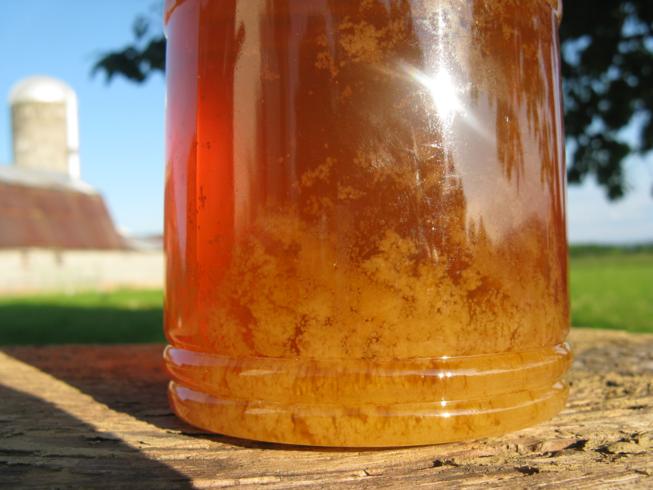
Do not fear however. The honey is still good to eat and will remain so for a very long time (excavations in egypt have uncovered honey hundreds of years old that was still perfectly edible). Some people end up prefering it in this state. Our head beekeeper James does!
If you would like to reliquify your honey then the best way to do that at home is to stand the jar in some hot water. Do not use boiling water. Use water that has been drawn from a hot tap unless you can accuratley measure the temperature of the water you are using. The reason for this is that honey has lots of delightfully helpful things in it such as enzymes and pollen. If heated too high these are killed off, and the honey can loose its aroma and taste becoming dark and unpalitable. Place your jar of honey into a heatproof container (a saucepan normally does the job), placing your jar of crystalising honey inside. Pour water into the saucepan up to the level of the honey inside. Do not remove the lid from the jar as honey is hydroscopic and will soon start to absorb the moisture from the room and the warm water.
